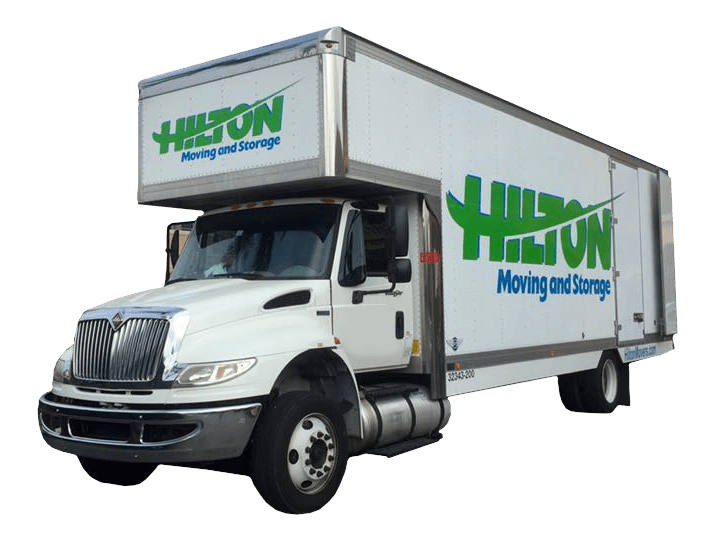
One of the quieter worries people have about a move is simple: how does anybody know where my things are? A truck pulls away from a house with several hundred boxes and pieces of furniture on it, and somewhere in there is the box with the good silverware, the one with the tax files, and the lamp that belonged to somebody’s mother.
Movers do keep track, and the system for doing it is older and simpler than most people expect. It is not a mystery, and it is not a computer doing it on its own. It is numbered tags, a written inventory and a set of condition notes, all of it handled by people. Here is how it works, and how you can use it to your advantage on move day.
Every item gets a number
Before anything goes on the truck, a member of the crew works through the house and tags what is being moved. Each piece of furniture gets a numbered sticker. Each box gets one too. Appliances, mirrors, mattresses, the lawn mower, the ladder in the garage — everything that is going gets a number.
Those numbers go onto an inventory sheet with a short description next to each one. Not “box,” but something specific enough to be useful later: “carton, kitchen,” “dresser, 6 drawer,” “mirror, framed.” Tags are usually applied somewhere out of sight, like the back of a headboard or the underside of a table, so you are not peeling stickers off the front of your furniture afterward.
The point of the numbering is not paperwork for its own sake. It is that at the other end, somebody counts. If the inventory says 212 items went on the truck, then 212 items come off it. Anything that does not get checked off gets looked for before the crew leaves, not a week later when the trail has gone cold.
Condition notes: what those codes mean
Next to each item on the inventory you will usually see a few letters or symbols. These are condition notes, and they describe the state the item was in before it went on the truck.
The vocabulary varies a little from company to company, but it covers things like scratched, dented, chipped, marred, soiled, worn, rubbed, or loose. There is usually a location code with it too, so a note might amount to “top surface, scratched” or “left leg, chipped.”
This is the part people skim, and it is the part most worth reading. Furniture that has lived in a house for fifteen years has marks on it. Documenting those marks at the start is what makes it possible to tell later whether something happened during the move or whether it was already there. It protects you, and it protects the crew from being blamed for a scratch that happened in 2019.
If you disagree with a condition note, say so while the crew is still in the house. Crews would far rather correct a note at the origin than argue about a table leg at the destination.
Walk your own inventory before you sign
At the end of loading, you will be asked to sign the inventory. It is tempting to sign it the way people sign a rental car agreement — quickly, because there is a lot going on and the day has been long.
Take the few minutes. Specifically:
- Check that the item count looks about right for what left the house
- Scan the condition notes on the pieces you care most about — the antique, the dining table, the piano
- Make sure anything you are not moving is not on the list, and anything you are moving is
- Ask about anything you do not understand, including the codes
Keep your copy. Do not put it in a box. Put it in the bag or folder that stays with you, along with your other move paperwork. At delivery it is the document you will be working from, and it is very hard to check a shipment in against an inventory sheet that is inside the shipment.
What happens on the truck
How a truck is loaded is part of the tracking system, not separate from it. Items go on in a planned order, with heavy and sturdy pieces forming the base tiers and lighter, more fragile items placed above and secured. Furniture is pad-wrapped and tied off so it cannot shift on the road.
On a local move within Naples or over to Marco Island, the shipment is on one truck and it goes from one address to the other the same day. Long-distance is where people get nervous, and it is fair to ask how a shipment stays together across several states. The answer is that the shipment is loaded as a unit, kept as a unit, and checked against the same inventory at delivery. As an agent of Bekins, we handle interstate moves as well as local ones, so the same inventory follows the shipment from your old address to your new one.
When things go to the warehouse in between
Plenty of moves have a gap in the middle. The closing slipped, the new place needs floors done first, or somebody is between a sale and a purchase. In those cases the shipment comes to our warehouse in Naples and waits there.
The tracking gets tighter at that point, not looser. Items come off the truck and are checked in against the same inventory, and your shipment is kept together and labeled as one household rather than scattered across the building. Our staff handles all of it, so your belongings stay identified as yours rather than mixed in with another family’s.
It is worth saying plainly what this is and is not, because people picture the wrong thing. This is warehouse storage run by our staff inside one 30,000 square foot climate-controlled building on Shearwater Street in Naples. It is not a rented unit. There is no gate code and no drive-up door, and customers do not come in to pull things out. When you are ready, you call us, our crew loads your shipment out, and we deliver it.
If you know there is something you will need before the household arrives — seasonal clothing, a set of files, the beach chairs — say so before the truck is loaded, and keep those items with you instead. Setting a few things aside on the front end takes a minute. Going to find one carton in the middle of a shipment that has been stacked and stored for six weeks is a real project.
Delivery day: checking the shipment back in
At the new address, the inventory gets used in reverse. As items come off the truck, somebody reads the numbers and somebody checks them off. This is the part where your copy of the inventory earns its keep.
Here is how to make it work well:
- Pick a spot and stay there. Stand where you can see items coming in, and check them off as they pass. It is much harder to reconstruct later from memory.
- If you cannot do it yourself, send somebody who can. A spouse, an adult child, a friend. Somebody should be watching the count.
- Look at the big pieces as they come in. Not every box, but the furniture — while the crew is still there.
- Note anything on the paperwork before you sign. A note written at delivery carries far more weight than a phone call three days later.
- Say where things go. Rooms should be marked on the boxes, but crews cannot read your mind about which bedroom is which. Ten seconds of direction saves you carrying a box upstairs yourself next week.
If a number does not get checked off, tell the crew leader before the truck leaves. Most of the time it turns up on the truck, behind something, within a few minutes. That is exactly the sort of thing the numbering system exists to catch.
What you can do on your end
Our system handles the tracking. But if you are packing some of your own boxes, a little discipline on your end makes the whole day smoother.
Write the room on the box, on more than one side, and write what is in it in general terms. “Kitchen — pots, baking” beats “Kitchen.” Mark the boxes you want first — coffee, bedding, towels, phone chargers, a roll of paper towels — clearly enough that they can be set aside where you can reach them.
Keep the things you genuinely cannot replace with you rather than on the truck: passports, deeds, medications, jewelry, a laptop, the external drive with the family photos. That is not about doubting the crew. It is that a document you need on Tuesday should not be in a truck that arrives Thursday.
And if you are moving a household in stages — some now, some after a renovation — keep the two groups obviously separate, and tell us which is which before loading starts. Sorting that out in the driveway wastes everybody’s morning.
The short version
Numbered tags on every item. A written inventory with condition notes. Your signature at origin, your copy in your hand, and a check-off at delivery. It is a simple system, it has been in use for a long time, and it works — as long as somebody on your side is reading it rather than signing it.
We have been moving and storing households in Southwest Florida since 2010, and we serve Naples, Marco Island, Bonita Springs, Estero, Golden Gate, Pelican Bay, Pine Ridge, Vineyards and Lely Resort.
If you have a move coming up and want to talk through how your shipment will be tracked and stored, call us at (239) 231-7050 or email info@hiltonmovers.com.