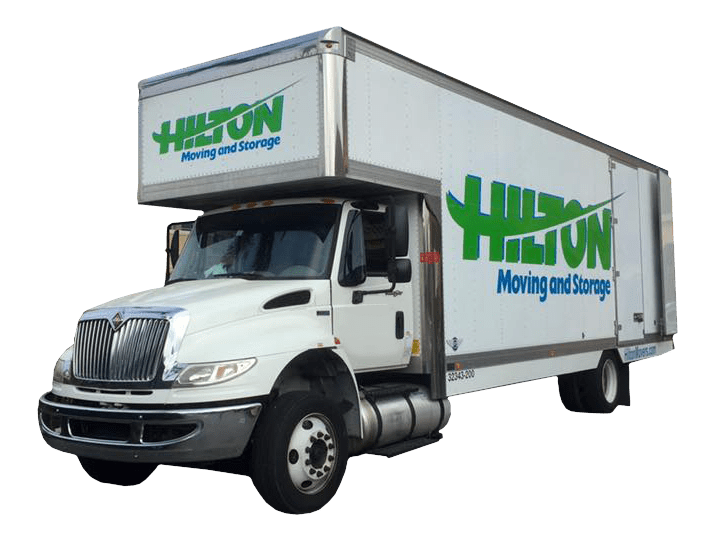
People plan their move around the inside of the house. They think about boxes, furniture, which room gets packed first. Almost nobody thinks about where the truck is going to sit — and in Southwest Florida, that turns out to be one of the details that shapes the whole day.
A moving truck is large, tall and heavy. Where it can park, how close it can get, and whether it can get through the gate at all are practical questions with real consequences for how long the move takes. Here is what to look at before moving day.
Why the parking spot matters
Every item in your home has to travel from the room it is in to the back of the truck. The distance between the front door and the truck is walked over and over, by people carrying things, all day long.
When the truck is at the end of the driveway, that walk is short. When the truck has to sit down the street, or outside a gate, or in a visitor lot a building away, that walk becomes the single biggest factor in how long the day runs. The industry has a name for it — a long carry — and it is worth knowing about in advance rather than discovering it at eight in the morning.
The good news is that almost all of it is solvable with a phone call a week ahead.
Gated communities and guard gates
A great many homes in Naples, Bonita Springs, Estero and Marco Island sit behind a gate, and gates have rules.
Call the guardhouse or the community office and ask what they need. Most communities want the moving company registered in advance, by name and sometimes by vehicle, so the gate is not holding up a truck while someone tries to reach you by phone. Some want a resident to call it in personally. Some issue a pass.
Ask about the gate itself, too. Some community entrances have a height restriction, a decorative arch, or a turn immediately past the gate that a long vehicle cannot make. If that is the case, there is usually a service entrance that commercial vehicles are directed to use instead. Find out which one before moving day, and tell us.
Ask about hours as well. Plenty of communities restrict when moving trucks and commercial vehicles may be on the property, and a few do not allow them on Sundays or holidays at all.
Community and association rules
Beyond the gate, many associations have their own requirements for a move. These vary a great deal from one community to the next, so the only reliable approach is to ask yours directly.
Common things to ask about: whether a move needs to be scheduled with the office in advance, whether there are permitted hours, whether there is a designated spot where a truck is supposed to park, whether elevators need to be reserved, and whether there is any paperwork the moving company is expected to provide. Ask what they need from us, and pass it along early so it is handled before the day rather than during it.
This applies to the new address as much as the old one. Two communities, two sets of rules, and the move touches both.
Driveways: width, slope and what is overhead
If the truck can use the driveway, the day gets easier. Three things decide whether it can.
Width. A truck needs room to pull in and room for people to work alongside it with the ramp down. A narrow driveway with plantings tight on both sides may physically fit the truck and still leave nowhere to stage items.
Surface and slope. Loaded trucks are heavy. Pavers, decorative concrete and older driveways can mark under that weight, and a steeply sloped driveway makes the ramp angle awkward. If you would rather the truck stay off the driveway entirely, say so — that is a normal request and it only causes a problem when nobody mentions it until the truck is already there.
Overhead clearance. This is the one that catches people. Low branches over the driveway, a porte-cochere, a carport, a decorative entry arch, or utility lines running across the approach. Look up at the path the truck would take and see what is above it.
Trimming a low branch in the week before the move is a small job that can change where the truck parks.
Street parking and the approach
When the driveway is out, the street is the next option, and the questions are similar. Is the street wide enough for a truck to park without blocking traffic. Is there a no-parking stretch. Is there a swale or soft shoulder that a heavy vehicle should stay off. Is there a mailbox cluster, a fire hydrant or a drainage grate in the obvious spot.
In some neighborhoods you may need to let neighbors know, simply so the space is clear that morning. A couple of cars parked in the wrong stretch on moving day can waste more time than anything else on this list.
If your street requires any kind of permit or notification for a commercial vehicle, check with your city or community office, and let us know what they tell you.
Condo, high-rise and multi-family buildings
Buildings usually have a designated loading area, and it is usually not the front entrance. There may be a service door, a freight elevator, a specific time window, and a requirement to pad the elevator before use.
This is a big enough subject that we covered it separately in our guide to moving into or out of a condo. The short version for access planning: find out where the truck is meant to sit, how far that is from the elevator, and whether the elevator has to be reserved.
When the truck cannot get close
Sometimes there is no way around it. The road is too narrow, the community does not allow a large vehicle past a certain point, or the building simply has no suitable spot.
In those situations the load is transferred using a smaller vehicle that can reach the home, working between the residence and where the larger truck is staged. It is a routine approach in the industry and it works well — but it adds handling and it adds time, so it is something to know about in advance rather than to improvise.
Either way, the earlier we know about the access situation, the better the plan. If we can see the address ahead of time, or you can describe it to us clearly, we can bring the right equipment for it.
Weather and the Florida afternoon
Between late spring and early fall, afternoon rain is a routine part of the day here. It does not stop a move, but it does affect how one is sequenced.
A truck parked close to the door means a short dash under cover. A truck parked a building away means a much longer exposure. It is one more reason the parking spot is worth sorting out in advance, and one more reason to start early in the day when the weather is generally more settled.
If your driveway or walkway tends to hold water, mention it. Knowing where the puddle forms changes where things get staged.
A short access checklist
Run through this a week or two before the move, for both addresses:
Call the gate or association and ask what they need and when trucks are allowed. Ask whether there is a service entrance or a designated truck spot. Check the driveway for width, slope and anything overhead. Check the street for parking restrictions and soft shoulders. Check whether an elevator needs reserving. Note the distance from the likely parking spot to the front door. Clear cars, bins and anything else out of the way the night before. Then tell us all of it.
Tell us early
None of this is complicated, and none of it is a problem when it is known in advance. It only becomes a problem when the truck arrives and finds a gate that will not open, a branch three inches too low, or a parking spot that is not there.
When you talk to us, describe the access at both ends: the gate, the driveway, the street, the building, the distance to the door. It is one of the most useful things you can tell us, and it directly affects how we plan the day. Our guide to getting an accurate moving estimate covers the other details worth mentioning up front.
Hilton Moving and Storage has served Naples and Southwest Florida since 2010, moving households throughout Naples, Marco Island, Bonita Springs, Estero, Golden Gate, Pelican Bay, Pine Ridge, Vineyards and Lely Resort. To talk through access at your address, call us at (239) 231-7050 or ask us for an estimate.